
Make a Basic Card and add reverse practice
Make a Basic Card with a clear question, a useful answer, and optional practice in both directions.
A Basic Card has a question and an answer. Ask one focused question that makes you recall and explain an idea. Keep the evidence and longer explanation in the answer.
Create it from Library
Open a Note, choose Cards, then Add card to learning note. Select Basic and fill in Question and Answer. Use the formatting button when bold or italic words make the question easier to scan.
This example compares two changes in nerve cells. A sodium channel lets sodium enter during a signal. A pump uses ATP (the cell’s energy supply) to keep sodium and potassium levels apart. Blocking the channel cuts inward current by 92% and stops signals within 2 minutes, while ATP and resting voltage stay near their starting levels. A separate treatment lowers ATP; after 30 minutes, pump transport falls, sodium inside the cell rises, and voltage shifts from −68 mV to −58 mV.
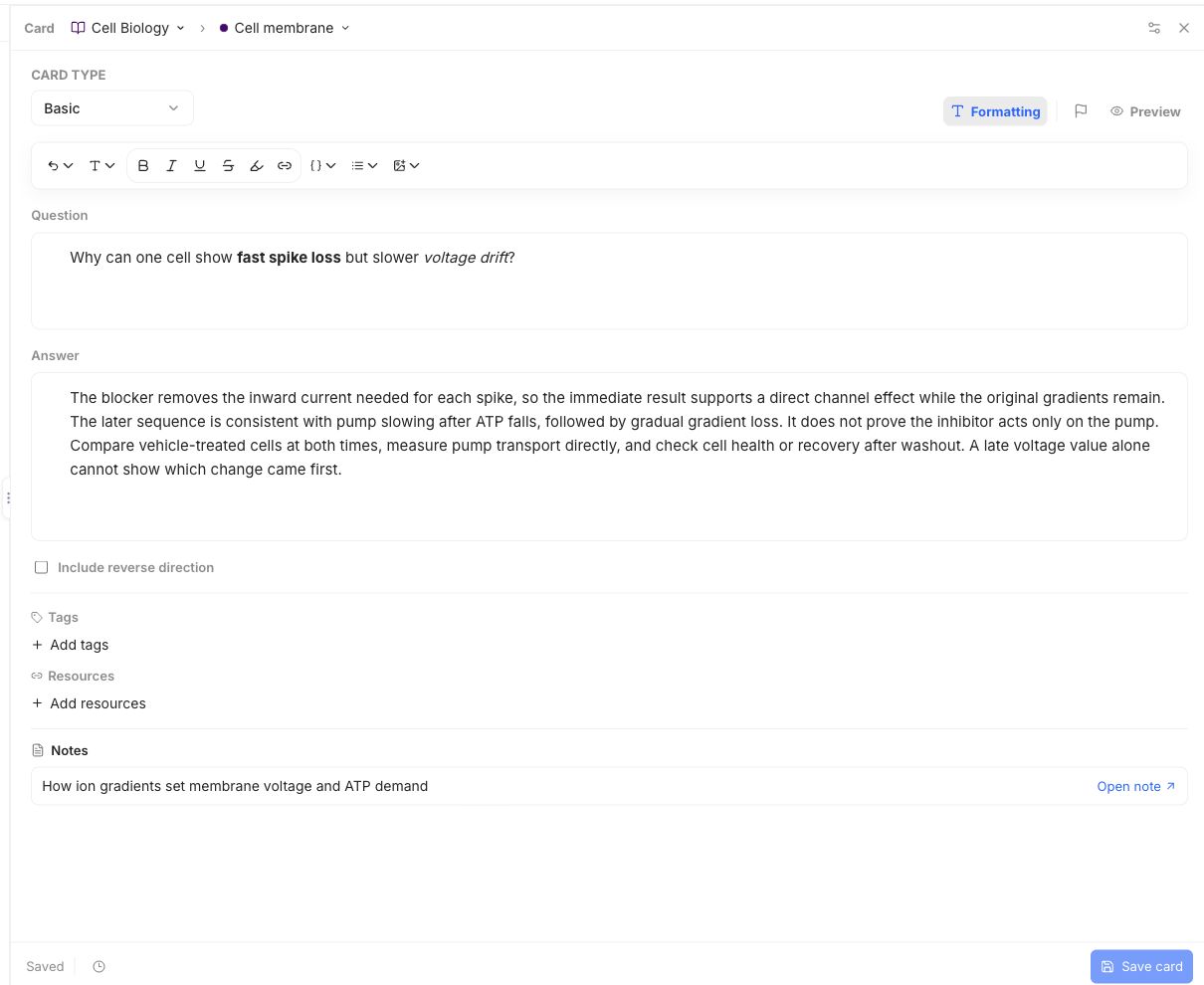
The question is short enough to answer from memory. The answer explains the quick channel effect, the slower pattern, and why the later measurements alone do not prove what caused the change. It also names checks that would make the conclusion stronger.
Choose Include reverse direction only when the answer also makes a useful question. Leave it off here: this explanation does not make a clear reverse question.
Save the Card and wait for Saved. In a Review, you can try the question before revealing the answer. See the quickstart for the connected Note and other Card types.
Choose Typed answer when you want to state a precise conclusion, Cloze to fill connected gaps, or a List to rebuild steps.